Rust solo survival versus clan play which path fits your wipe and why
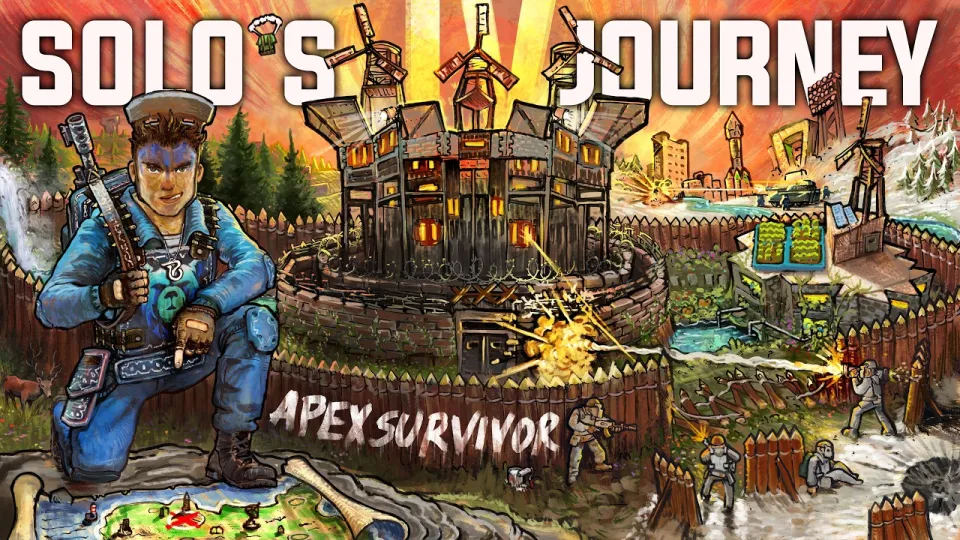
Video: Rust - A Solo's Journey IV: Apex Survivor (Movie)
Want articles like this for your own video to promote it on YouTube and Google? Order them through the Telegram bot @sat_sit_bot. The bot writes and publishes the articles itself (with your YouTube video embedded) on popular topical websites (no ads). Your first 50 articles are free.
· based on the channel Blooprint
Key takeaways
- Blooprint's "A Solo's Journey IV: Apex Survivor" covers 14 days of solo Rust in a single movie with 13 chapters plus an epilogue.
- The film runs roughly 4 hours 50 minutes and was edited and filmed by Blooprint himself, with over 300 hours of production work claimed.
- A companion tracker at solosjourneytracker.com maps any timestamp to the player's progress during the challenge.
- Solo Rust removes clan support: no shared farm, no instant respawn backup, no split loot, but also no loot drama.
- Common viewer doubts center on base design (triangle vs square cores), long-wipe burnout and the value of a 5-hour watch.
Rust solo survival is the harder but more self-contained way to play: one player farms, builds, defends and raids alone, so every decision carries full risk and full reward. Clan play spreads that risk across several people, which speeds up progression but adds coordination and loot-sharing friction. Blooprint's "A Solo's Journey IV: Apex Survivor" is the clearest recent demonstration of the solo path — 14 days, one player, one wipe — and the companion tracker at solosjourneytracker.com lets you type in any timestamp and see exactly where his progress stood at that moment.
What Rust solo survival actually demands from one player
Solo Rust compresses every role in a clan into a single schedule. On a vanilla or lightly modded server, a solo player has to cover farming, base construction, defense, scouting and raiding without help, and the time budget is the real constraint.
- Farming. Nodes, barrels and hemp are gathered by one person, so a solo player typically builds smaller and upgrades later than a group.
- Base work. A compact starter near a monument, then a main base with layered doors and a secure core, is the standard solo progression.
- Defense. Without teammates, offline protection matters more than online skill — honeycomb, shotgun traps and well-placed doors do the work you cannot.
- Raiding. Solo raids are usually opportunistic: a decayed base, a weak door, a sleeping neighbor. Full-scale sulfur raids are rare unless the wipe is long.
- Regear discipline. Losing a kit solo means rebuilding from scratch, so stash caches and backup kits are not optional.
The upside is total control. There is no argument over who gets the rocket launcher, no waiting for a clanmate to log in, and no internal drama over loot. The downside is that a single bad fight or a determined offline raid can erase days of work in minutes.
How clan play changes the same wipe
A clan turns the same map into a logistics operation. Groups split farming, run dedicated builders, keep a scrap economy going and can contest monuments and cargo ship runs with numbers. Progression is faster, bases are bigger and raids are planned rather than improvised.
The costs are real too. Loot distribution needs rules, activity levels vary, and one inactive member can leave a base undefended. Clans also attract attention: a large compound is a visible target, and rival groups will test it. For players with limited playtime or a preference for quiet progression, a small group of two or three often beats both extremes.
Where the solo movie earns its runtime
Blooprint's film is structured as 13 chapters plus an epilogue, running close to five hours, and it treats a solo wipe as a story rather than a highlight reel. The pacing follows the natural arc of a long wipe: early scrapping, base expansion, mid-wipe conflict and late-wipe raids. Chapters break the runtime into watchable blocks, which is why viewers describe it as something to return to across several sessions rather than one sitting.
The production is unusually heavy for Rust content — filming and editing were done by Blooprint, with an animated intro, custom thumbnail art, motion design and cinematic support credited to separate artists. A licensed soundtrack from Epidemic Sound, Artlist and the artist aloneintokyo underpins the pacing. The result reads less like a gameplay VOD and more like a documentary about one player against a server.
Base design lessons solo players can copy
Solo base design is a trade-off between cost and survivability, and the discussion around the movie keeps returning to core shape. Square cores are cheap and fast to build; triangle cores cost more materials but create awkward angles, extra doors and a tighter loot room that raiders must spend more explosives to reach.
- Keep the core small. A 1x1 or 1x2 loot room with sheet metal or armored upgrade is cheaper to secure than a large open core.
- Layer the entrances. Multiple airlocks and offset doors force raiders to burn more boom per meter of progress.
- Use the terrain. Building against a rock or cliff removes walls an attacker would otherwise need to break.
- Separate the farm base. A small, cheap outpost near a monument protects your main base from being found through routine traffic.
- Plan for decay. Solo players who cannot log in daily should keep the main base compact enough to afford upkeep.
A farm base is not a weakness; it is how solo players keep resources flowing while the main base stays hidden and upgraded.
Common doubts about long solo wipes
Long wipes raise practical questions, and the most frequent ones are about time, burnout and whether a five-hour video is worth starting.
- Time commitment. A 14-day solo run does not require 14 full days of play; it requires consistent sessions and a plan for what to do in each one.
- Burnout. Progress stalls are normal. Switching between farming, monuments and small raids keeps a wipe from becoming a grind.
- Server choice. Low-population or monthly-wipe servers make solo progression far more forgiving than weekly high-pop servers.
- Watch order. Chapters make the movie easy to split; the tracker exists precisely so viewers can jump in and out without losing the thread.
- Toxicity. Solo play exposes you to more random encounters, so muting, reporting and picking fights carefully matter as much as aim.
Useful links
- Progress tracker for the solo movie: https://solosjourneytracker.com
- Blooprint vinyl figure (limited run): https://youtooz.com/products/blooprint
- Solo's Journey mousepads and playmats: https://epicdesk.shop/collections/blooprint
- Animated intro studio: https://x.com/highresolution0
- Thumbnail artist: https://twitter.com/veys_el_kara
Final take on solo versus clan Rust
Solo Rust rewards planning, patience and base discipline more than raw aim, while clan Rust rewards coordination and volume of playtime. If you want a wipe where every decision is yours and every loss is yours to absorb, solo is the honest choice; if you want big bases and scheduled raids, a small group is more efficient. Blooprint's "A Solo's Journey IV: Apex Survivor" is the best available argument for the solo path, and the channel Blooprint deserves credit for treating a 14-day wipe as a full narrative. Before starting your own run, open the Solo's Journey tracker to see how progress maps to time and set realistic goals for your wipe.
Questions & answers
Is Rust playable entirely solo?
Yes. Solo Rust is viable on most servers, especially low-population or monthly-wipe ones. The main adjustments are smaller bases, careful raiding and stashing backup kits, since you have no teammates to regear you after a loss.
How long does a solo Rust wipe take to feel complete?
Most solo players consider a wipe successful once they have a stable base, a reliable scrap income and at least one raid or major fight. That usually takes several sessions spread across a week or two rather than one long sitting.
Is a five-hour Rust movie worth watching in full?
It depends on what you want. The chapter structure makes it easy to watch in blocks, and a timestamp tracker lets you resume without confusion. Viewers who enjoy long-form storytelling tend to finish it; others treat it as background viewing.
What base design works best for a solo player?
A compact core with layered doors and honeycomb, ideally built against terrain, performs better than a large open base. A separate cheap farm base near a monument keeps resources flowing without exposing your main loot room.
Source: Rust - A Solo's Journey IV: Apex Survivor (Movie) · Markdown version